

Serious drinking water shortages, far from our beds? There is an increasing need for ever scarcer drinking water. By 2030, the Netherlands will need approximately 100 million cubic metres more drinking water than in 2020. This is almost the equivalent of 40,000 Olympic swimming pools. Dutch water companies such as Vitens predict scarcity and supply uncertainty.
Ron Hulst, R&D Manager at Royal Van Wijhe Verf: ‘Major drinking water companies warn that in such cases, consumers will take precedence over industries and businesses. We have long recognised the urgency of this issue and are investigating ways to save water, reuse it and find alternative sources. With success.’

‘Van Wijhe explores four concept paint variations based on water.
‘Van Wijhe explores four concept paint variations based on water. About ten years ago, the idea of doing something with salt water took root in the mind of Marlies van Wijhe, CEO of Royal Van Wijhe Verf. Marlies: ‘The idea just kept nagging at me. As long as it hasn’t been proven that it can’t be done, I think it’s worth looking into seriously. That’s just how I am. Two years ago, the opportunity arose for two students – one from chemistry, the other from logistics – to carry out an assignment and investigate this further. The main conclusions summarised: not impossible, offers starting points. This was the impetus for us to conduct further research.’
Marlies shares her fascination with water with Ron Hulst. Ron talks at length about the phenomenon of water and the state of his research: ‘Not only is society using more and more water, but it is also becoming increasingly scarce due to climate change, population growth and pollution. We pollute the sea, discharge waste into rivers and contaminate groundwater through agriculture, industry and household waste. Microplastics, PFAS, medicines, drugs… it is becoming increasingly difficult to remove this pollution. Clean water (i.e. drinking water/tap water) is becoming scarce.
Water is becoming a scarce commodity. This is why Royal Van Wijhe Verf is investigating the possibilities of alternative water sources. At Wydo, we have been researching the possibilities of rainwater, process water, seawater and brackish water for some time now.
The initial results are surprising and encouraging. We hope this will set off a wave of change and encourage other parties to start similar research or to collaborate with us to accelerate the necessary water transition. Before legislation forces us to do so and it is too late. That is why we are now sharing the preliminary results.’
Wydo innovations
Wydo NBD is an independently operating corporate spin-off of the family business Koninklijke Van Wijhe Verf in Zwolle, which is committed to making the paint sector more sustainable. Through Wydo, the company also wants to make knowledge and expertise available to the manufacturing industry outside the paint sector. Sustainable innovation is the keyword in Wydo’s activities. Wydo focuses explicitly on R&D and innovation projects that contribute to achieving environmental and climate objectives and preserving biodiversity.Wydo seeks innovation in research and application from renewable raw materials, enabling producers to reduce the carbon footprint of their activities.
Wydo is located in Groningen on the Zernike Campus. This was a conscious choice, as Groningen is a hotspot for the biobased economy and has excellent facilities and highly educated scientists. This makes it easy to establish short lines of communication with researchers from a wide range of fields. Wydo collaborates with several universities and knowledge institutes.

Rainwater as an alternative source
‘Royal Van Wijhe Verf consumes a considerable amount of water annually, around 3.5 to 4 million litres. Some of this is used in the production processes, and some in the water-based products. In principle, we can meet our own water needs by collecting rainwater from the flat roofs of our buildings at our two locations in Zwolle. Except during periods of extreme drought.
Every drop counts. The challenge is to collect and store this water properly and to guarantee its quality. Fortunately, our factory has an existing storage location that is suitable for this purpose. The quality of rainwater is quite good for industrial use. We have tested the water and it is microbiologically sound. However, the quality is not guaranteed, nor is it constant. What if there is a dead bird on the roof? You don’t want to introduce contamination into the factory and the products. Is the colour of the water consistent? Even a small piece of rust can cause slight discolouration, which will be visible in white paint. That’s not what you want.
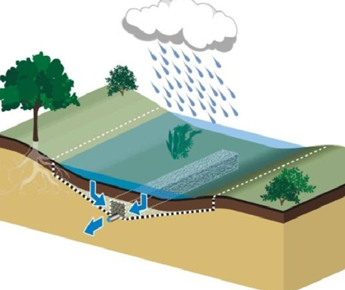
Fortunately, nature gives us a helping hand. We assume a scenario in which we first temporarily store the water in a wadi*, where it is naturally purified and decoloured. This is followed by a filtration step using, for example, activated carbon to prevent microbiological contamination.’
A UV street is then used to remove the last minor chemical disturbances. It’s not rocket science, just tried and tested techniques. The biggest challenge is preventing the formation of biofilms, a slimy layer of micro-organisms in a protective matrix. Biofilms are found on hard surfaces, such as the inside of pipes and the like. These are difficult to dissolve. The use of rainwater is a promising option, and additional research is ongoing.
*A wadi is a shallow, grass-covered depression that collects rainwater, allowing it to slowly infiltrate the soil and purify the water as sand, plants and soil organisms break down dirt and contaminants.
Circular process water
‘It is worth mentioning what we are already doing with our process water in this context. Working towards a sustainable future also means handling industrial waste carefully. For this reason, our cleaning water, i.e. water used to clean tanks, for example, is first stripped of all kinds of chemical contaminants before it is discharged into the sewer system. It complies with the discharge standards set by the government. We are going one step further by looking into whether we can reuse the so-called press cake, the residue, as a filler in paint. We also want to reuse the relatively clean residual water, either as water for cleaning or as reusable water in our production or products.’
Seawater
‘With seawater, most of the challenges lie in achieving a stable output. The water is full of salts. Can you use it to make paint? Suppose you succeed, what happens in the long term once the layer has been applied? Salt attracts moisture anyway. And there is a good chance that the salt will crystallise during its lifetime, a process known as salting out. You want to prevent that. Unfortunately, we do not yet have any long-term results. However, we did conduct a test based on a product for carpentry / joinery factories. The quality must therefore meet the requirements set by joinery products.
We created a “ladder” of seawater percentages, successively 10%, 20% and 30% seawater in the paint, and assessed the results. Among other things, we measured the water absorption. This showcase shows that you can use a considerable amount of seawater and still achieve encouraging results. Further research is needed to see what you can do with it and, of course, what you cannot do with it.’

Brackish water
In the south-east region West Brabant, water company Brabant Water is investigating the possibilities of turning brackish water into drinking water. Brackish water is water that contains a small amount of salt. It comes from an ancient sea layer deep underground (200 to 260 metres deep). Because it is outside the existing freshwater system, pumping it up has less impact on agriculture and nature. It is less salty than seawater.
‘The trial in Brabant produced test water that they did not want to throw away. They made the purified brackish test water that they could no longer use available to us, as well as a jerry can of water purified and desalinated by them using osmosis. Call it circular collaboration: they didn’t have to throw away the test water and we turned it into paint. The brackish test water gives slightly better results than the paint made with seawater. As expected, the desalinated brackish water behaves like tap water in our tests. So it’s a very promising option.’
Between dream and reality
‘One of the UN’s Sustainable Development Goals (SDG6) is “to ensure clean water and sanitation for all, with the aim of providing access to safe drinking water and sanitation for everyone, and sustainable management of water resources, wastewater and ecosystems”. This goal will come under increasing pressure in the coming years.
The urgency is now. Tapping into alternative sources is essential. The costs of water and purification will rise sharply in the coming years. Cleaning and reusing water, such as with desalination techniques like reverse osmosis and distillation, consumes a significant amount of energy. Industry is encountering challenges with the overloaded power grid. Our biggest challenge is to obtain clean water that does not contaminate the paint and pipes. We are working hard on this. In order to start a “water wave” of change, we will be taking a closer look at our findings for each alternative source in the coming period. Innovation is key. Joint innovations are bringing sustainable management ever closer. Let’s accelerate and realise the water transition by sharing knowledge and inspiring each other.’
Scientist Ron Hulst about water:
‘Water is the most studied and least understood molecule in the world. We all learn that it is H2O, but it is so much more than that. Water forms hydrogen bonds, which give it its unique properties. And then there are the trace elements found in water. These largely determine how water behaves. Did you know that there are as many as 150 types of water available for research purposes? From which certain traces have been removed, or all salts, as in demineralised water. From expensive to very expensive. It is quite difficult to make water drinkable. Water is life and life is water. We are spoiled by the availability of drinking water, but in countries such as Africa and India, it is a completely different story. We are still not sufficiently aware that 24-hour availability will soon be a thing of the past here too. This awareness is necessary in order to drastically reduce water consumption and accelerate the water transition.
The water problem is not new. Nostradamus, the famous 16th-century French seer, is known for his cryptic predictions. In recent interpretations of his quatrains for 2025, water is mentioned remarkably often: “Water Empire”. Some sources suggest that Nostradamus predicted a ‘water empire’, which could indicate an era in which water is central to geopolitics, economics and even conflicts. This is often interpreted as a warning about water shortages, flooding or the importance of water as a source of life in the future. That future is now.’

Concept Paints
Marlies van Wijhe, CEO of Royal Van Wijhe Verf, on the Concept Paints phenomenon: ‘It started as a Friday afternoon experiment. I asked Ron Hulst, R&D Manager, whether he liked the idea of Concept Paints. You could compare it to concept cars in the automotive industry. First, to show internally what we are capable of. To show that we are on the right track. And then externally. To interest suppliers of raw materials and strengthen each other. To set something in motion. For the same reason, we are now presenting our latest development in this concept form.
Two years ago, it was Flower Power wall paint, last year it was Biomotion70, and now it is our search for alternative sources for increasingly scarce drinking water. As a child, a school project called “Be smarter with water” made me aware of the importance of using water sparingly. That project had such an impact on me that I always use our drinking water sparingly. We invite people or parties who are involved in innovation or who want to contribute in any way to join us. Together we can achieve more. We are enthusiastic about a sustainable and climate-neutral future. That is why we are happy to share what we are doing in the laboratory to make that happen. Such as our groundbreaking developments with Concept Paints.’
Read about previous concept paints at www.conceptpaint.nl. The details and results of the water variants will also be published on this site during the course of 2026.